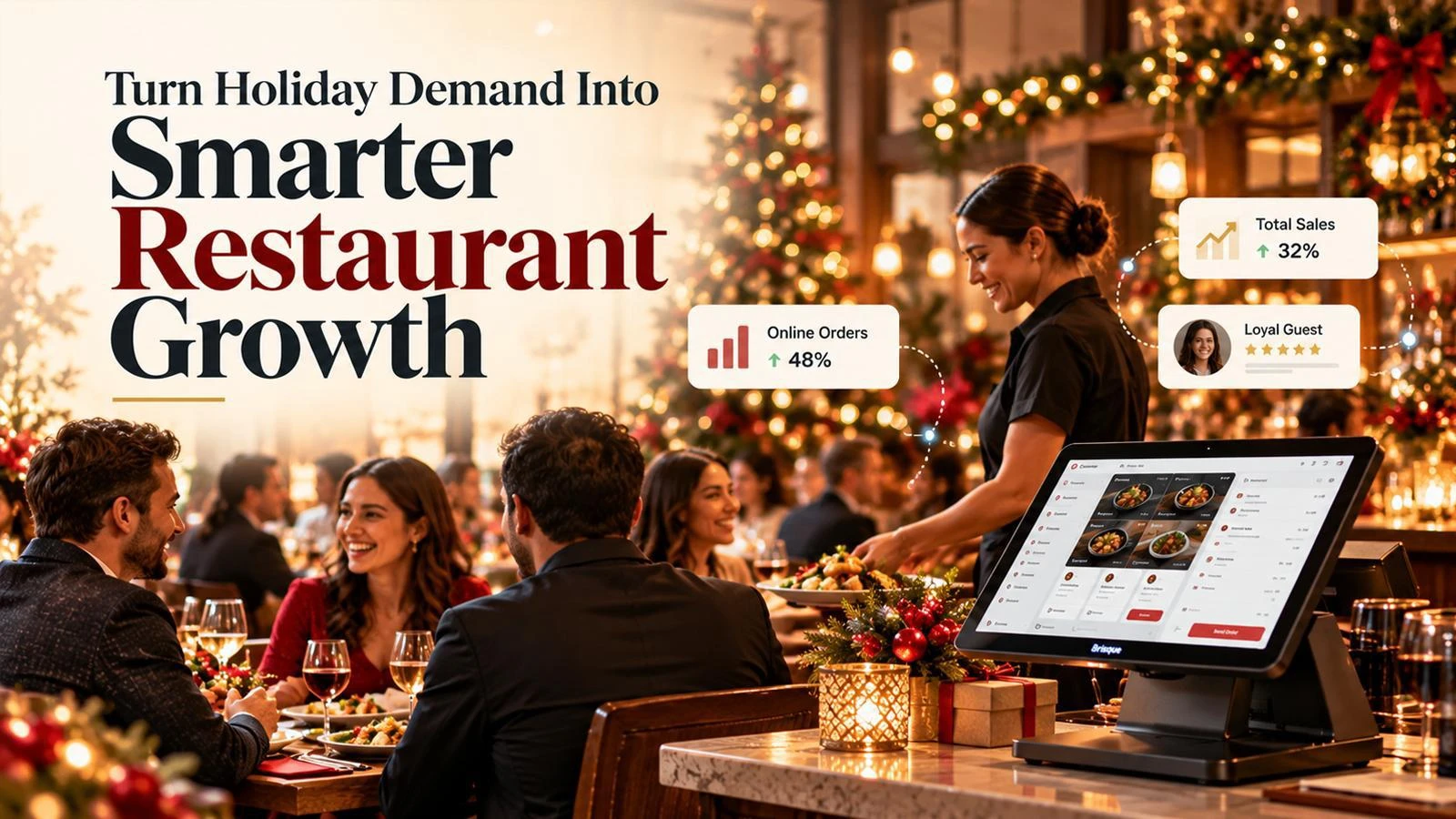
Key takeaways
- Plan holiday campaigns from October so you capture catering, group and advance orders.
- Promote value, convenience and experience, not just discounts, and check contribution margin first.
- Make sure online ordering matches your kitchen capacity before the rush begins.
- Use loyalty and follow-up offers to turn holiday guests into regulars in January.
- Measure profitability and repeat business, not only total sales.
Introduction: Make This Holiday Season a Growth Opportunity
The winter holiday season is one of the most important opportunities for restaurants across the United States. From Thanksgiving gatherings and office celebrations to Christmas dinners, Hanukkah celebrations, New Year's Eve parties, and winter takeout orders, customers look for convenient dining, memorable experiences, seasonal menus, and ways to celebrate with family and friends.
For restaurant owners, however, the season brings more than an opportunity to increase sales. It also brings operational pressure. Higher order volumes, fluctuating staffing requirements, ingredient costs, delivery coordination, and customer expectations can make the difference between a profitable holiday season and a stressful one.
The solution is not simply to offer more discounts or advertise more frequently. Restaurants need a coordinated strategy that connects marketing, sales, service, and technology.
According to the National Restaurant Association's 2026 State of the Restaurant Industry report, U.S. restaurant and foodservice sales are projected to reach $1.55 trillion in 2026. The report also highlights ongoing cost pressures and the importance of technology investments that improve efficiency and strengthen guest relationships.1
For restaurants preparing for the holiday rush, this creates an important business opportunity: attract the right customers, make ordering easier, serve them efficiently, and encourage them to return after the celebrations end.
This is where a well-planned combination of Holiday Sales Strategies, Holiday Restaurant Marketing, and Restaurant Management Technology can make a difference.
With Brisque POS as part of a restaurant's technology strategy, operators can focus on connecting everyday sales and service workflows with a more organized approach to seasonal business growth.
1. Understand What Holiday Customers Want
Before planning holiday campaigns, restaurants need to understand why customers choose to dine out, order takeout, or celebrate at a particular establishment. Different customers have different priorities during the winter season.
- Families may want convenient group meals, festive menus, and predictable pricing.
- Office teams may need catering packages, group ordering, and reliable pickup times.
- Couples and small groups may look for special dining experiences and seasonal menus.
- Busy households may prefer prepared holiday meals, takeout bundles, or delivery.
- Regular customers may appreciate exclusive offers and personalized rewards.
The National Restaurant Association's 2026 industry research reports that 61% of adults consider dining out essential to their lifestyle, even as household budgets remain under pressure. Value offerings and loyalty programs are expected to influence restaurant choices.1
This finding has a practical implication for restaurants: holiday promotions should communicate value, convenience, and experience, not just lower prices.
A restaurant offering a clearly priced family meal, for example, may appeal to customers who want a convenient celebration without the work of preparing every dish at home. A café might promote seasonal drinks and bakery bundles, while a full-service restaurant could offer a reservation-based holiday menu.
The best Holiday Sales Strategies begin with understanding the customer and designing an offer that fits the occasion.
2. Build a Holiday Restaurant Marketing Plan Before the Rush
Successful Holiday Restaurant Marketing starts well before the busiest service days. Waiting until December to launch promotions can mean missing opportunities to secure catering orders, group reservations, and advance takeout bookings.
Restaurants should develop a seasonal calendar that covers the major holiday periods and gives customers enough time to plan.
Recommended holiday marketing timeline
Plan and prepare
- Finalize seasonal menus and pricing.
- Photograph holiday dishes and bundles.
- Prepare website banners, social media posts, and email campaigns.
- Set up online ordering options and review order capacity.
- Establish goals for sales, bookings, and customer retention.
Build awareness
- Announce Thanksgiving and winter holiday offerings.
- Promote catering and group meal packages.
- Encourage advance orders and reservations.
- Share behind-the-scenes content featuring seasonal preparation.
- Update business listings with accurate holiday hours.
Convert interest into orders
- Promote limited-time menus and convenient meal bundles.
- Share clear ordering deadlines and pickup instructions.
- Send relevant reminders to interested customers.
- Highlight availability for office parties, family gatherings, and New Year's Eve.
- Monitor order volume and campaign performance.
Retain customers
- Thank customers for celebrating with the restaurant.
- Promote weekday dining and quieter service periods.
- Invite customers to join loyalty programs where available.
- Review sales performance and identify which offers worked best.
This approach turns holiday marketing from a collection of last-minute posts into a planned business campaign.
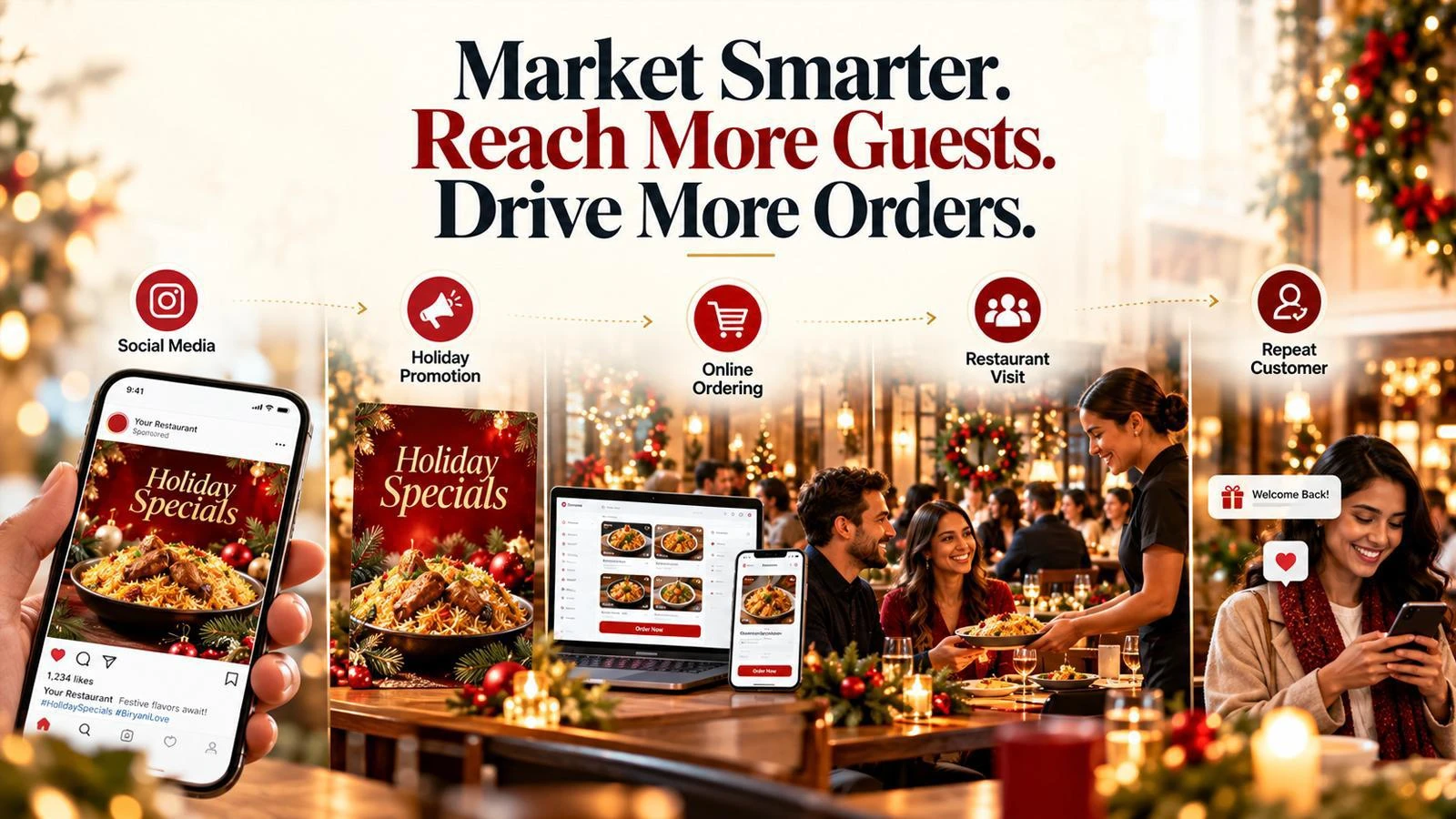
3. Use Restaurant Digital Marketing to Reach Customers Where They Are
Customers may discover a restaurant through a Google search, social media post, email, recommendation, or online menu. Restaurants should make it easy for customers to move from discovery to a completed order. A practical Restaurant Digital Marketing strategy should combine several channels.
Social media marketing
Use Instagram, Facebook, and other relevant channels to showcase seasonal food, holiday bundles, restaurant decorations, special events, and catering options. Instead of publishing only promotional graphics, mix in useful content:
- Short videos showing how holiday dishes are prepared.
- A guide to ordering meals for a family gathering.
- Staff recommendations for seasonal menu favorites.
- Clear explanations of catering packages and serving sizes.
- Reminders about holiday ordering deadlines.
Every promotional post should provide a clear next step, such as viewing the menu, placing an order, making a reservation, or contacting the restaurant.
Local search visibility
Customers frequently search for phrases such as "Thanksgiving takeout near me," "Christmas catering," or "restaurants open on New Year's Eve." Restaurants should keep their Google Business Profile, website, menus, and holiday hours accurate. Dedicated seasonal website pages can explain menu options, pricing, service availability, ordering deadlines, and pickup instructions.
Email and SMS marketing
Where customers have consented to receive communications, email and text messages can support timely, relevant promotions. For example, a restaurant might send an early announcement about Thanksgiving meal packages, followed by a reminder before the advance-order deadline.
The goal is to communicate information that helps customers make a decision, not to overwhelm them with repetitive discounts.
The National Restaurant Association's 2025 industry research identified digital marketing as a planned technology investment for 65% of restaurant operators surveyed. This signals that restaurants see digital outreach as an important part of attracting and retaining customers.2
For Brisque POS customers, the opportunity is to connect marketing activity with clear ordering paths and available sales information, using the relevant website, ordering, and marketing tools in their technology setup.
4. Design Restaurant Holiday Promotions That Protect Profitability
Discounting everything during the holidays may attract attention, but it can also reduce margins during a period when labor and ingredient costs are already challenging. Effective Restaurant Holiday Promotions should give customers a compelling reason to order while helping the restaurant manage preparation, pricing, and demand.
Five practical holiday promotion ideas
- 1
Family meal bundles
Combine a main dish, sides, and dessert into a clearly priced package. Bundles make purchasing easier for customers and can simplify preparation for the kitchen.
- 2
Seasonal limited-time menus
Introduce selected holiday dishes or beverages that fit the restaurant's identity. Limited-time items can generate interest without requiring a complete menu overhaul.
- 3
Catering and group packages
Create packages for office lunches, team celebrations, and family gatherings. Publish serving sizes, minimum order requirements, lead times, and delivery or pickup details.
- 4
Off-peak dining offers
Encourage visits on quieter days or during less busy periods instead of adding discounts to already crowded services. This can help distribute demand more evenly.
- 5
Loyalty-based rewards
Reward returning customers with relevant benefits, such as a seasonal add-on, a future-visit reward, or an offer on a complementary menu item.
Before launching any promotion, calculate its likely contribution margin. A package that generates more orders is not necessarily more profitable if its discount, food cost, packaging, and labor requirements are too high.
A Restaurant POS system can help operators examine sales mix and transaction patterns where suitable reporting is available. These insights can help the team compare promotional performance and refine future offers.
5. Make Your Restaurant Online Ordering System Holiday-Ready
During the winter holidays, online ordering can help customers arrange meals around busy schedules, family gatherings, and office events. However, a Restaurant Online Ordering System needs more than an attractive menu. It must support the restaurant's actual operational capacity.
Holiday ordering checklist
- Are seasonal menu items available and correctly priced?
- Are modifiers, sides, and dietary details clearly explained?
- Can customers select appropriate pickup times?
- Are large orders subject to advance notice?
- Are order limits needed for particular time slots?
- Are pickup instructions and holiday hours easy to find?
- Can staff manage online orders alongside dine-in business?
- Are customers informed if an item becomes unavailable?
Restaurants should also decide which ordering channels make sense for their business. Direct ordering through a restaurant's website may support a more direct customer relationship, while third-party marketplaces can help reach additional audiences. The best mix depends on customer demand, fees, operational capacity, and the restaurant's goals.
When a Restaurant Online Ordering System is integrated appropriately with a Restaurant POS system, the team can reduce manual order entry and improve visibility into incoming demand.
For example, if a restaurant sells holiday meal packages through an online channel, connected order workflows can help staff receive the order details and prepare the correct items. Integration capabilities vary by provider and configuration, so operators should confirm the exact workflow supported by their setup before the holiday rush.
6. Use Restaurant POS Software in the USA to Improve Holiday Operations
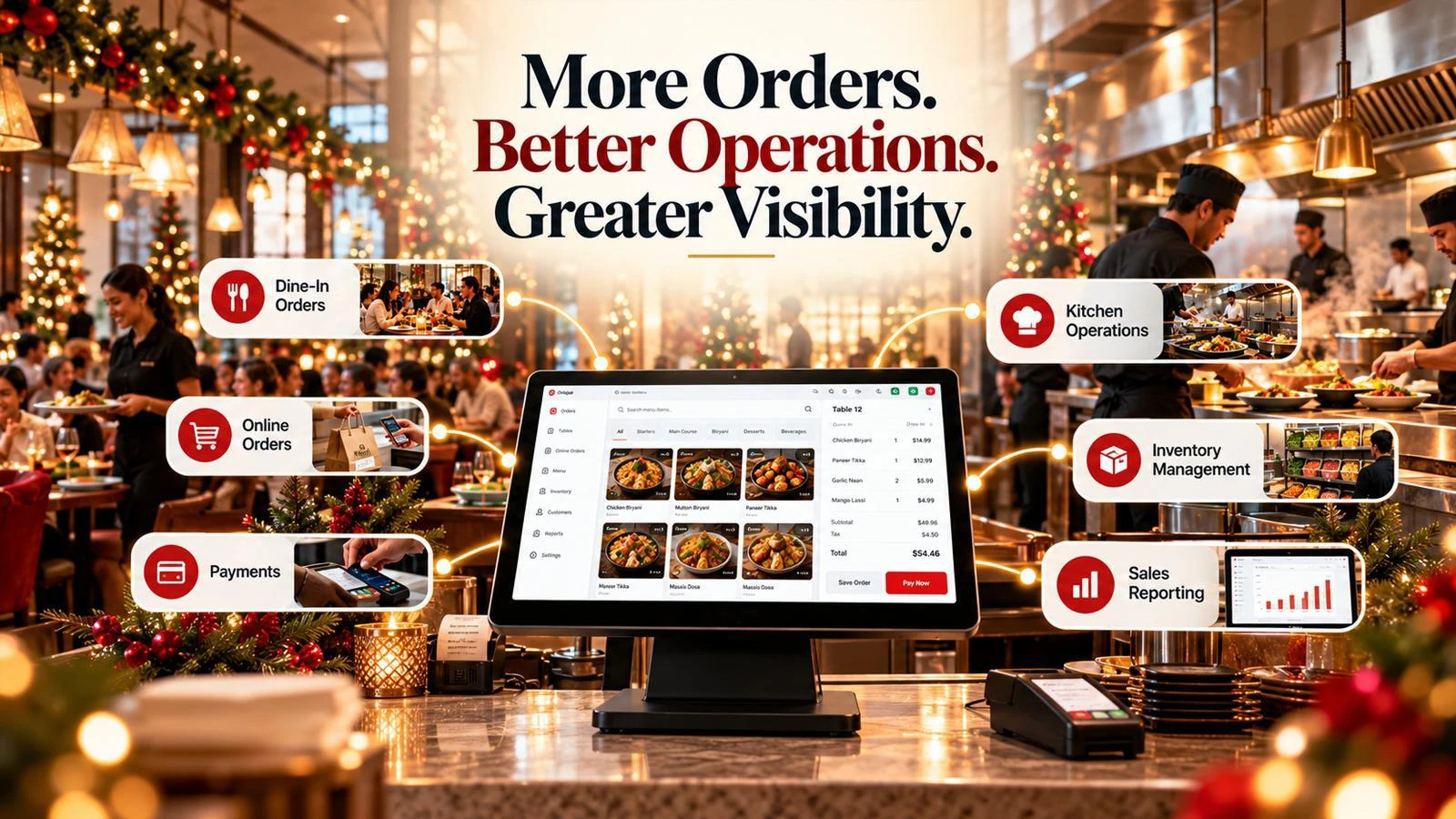
A restaurant's point-of-sale system plays an important role during high-volume periods because it sits close to the moment when customer demand becomes a transaction. Modern Restaurant POS Software in the USA may support sales recording, menu management, payment processing, order workflows, and reporting, depending on the product and configuration.
For holiday operations, these capabilities can support several practical goals.
Faster, more consistent order handling
Clearly configured menus, modifiers, and ordering workflows help employees enter orders accurately. This matters when customers are choosing between regular menu items, seasonal specials, bundles, and customized meals.
Better visibility into sales
Sales reporting can help managers identify popular dishes, compare performance across periods, and assess whether promotions are generating the intended results.
More organized service
Where the relevant integrations are supported, POS workflows can connect with kitchen displays, online ordering, payment tools, and other systems. This can help reduce unnecessary manual steps.
Better post-holiday analysis
Once the season ends, managers can review order volume, average transaction value, product mix, and promotional performance to inform next year's plans.
For Brisque POS, the relevant value proposition is helping restaurants build a more organized approach to POS-led operations and sales visibility. Restaurants should verify specific reporting, integrations, and feature availability against their Brisque configuration before relying on them for a particular workflow.
Technology works best when the restaurant team understands how to use it. Brief staff training, menu testing, and a practice run of holiday order scenarios should be part of the preparation process.
7. Strengthen Restaurant Customer Engagement With Loyalty Programs
A successful holiday campaign should do more than bring customers in once. It should give them a reason to return. Restaurant loyalty programs can support this goal by rewarding repeat business and making customers feel recognized.
The National Restaurant Association's 2024 Restaurant Technology Landscape research found that 52% of surveyed adults participated in a restaurant, coffee shop, snack place, or deli loyalty or rewards program. Among loyalty participants, 96% said these programs were a good way to get more value for their money.3
These findings suggest that value and rewards can matter to customers. They do not guarantee that every loyalty program will increase sales; the results depend on the offer, customer participation, and program execution.
Restaurants can build seasonal Restaurant Customer Engagement through simple ideas:
- Offer a reward for a qualifying repeat visit.
- Invite customers to join a loyalty program at checkout.
- Share a January promotion with customers who have opted in.
- Recognize frequent customers with relevant seasonal offers.
- Encourage customers to share feedback after a holiday meal.
- Tailor offers to customer preferences where the available data and permissions allow it.
For example, a customer who orders a holiday family meal might appreciate an offer for a future family dinner. A café customer who frequently buys seasonal drinks might respond better to a beverage-related reward. The principle is to make the next visit relevant.
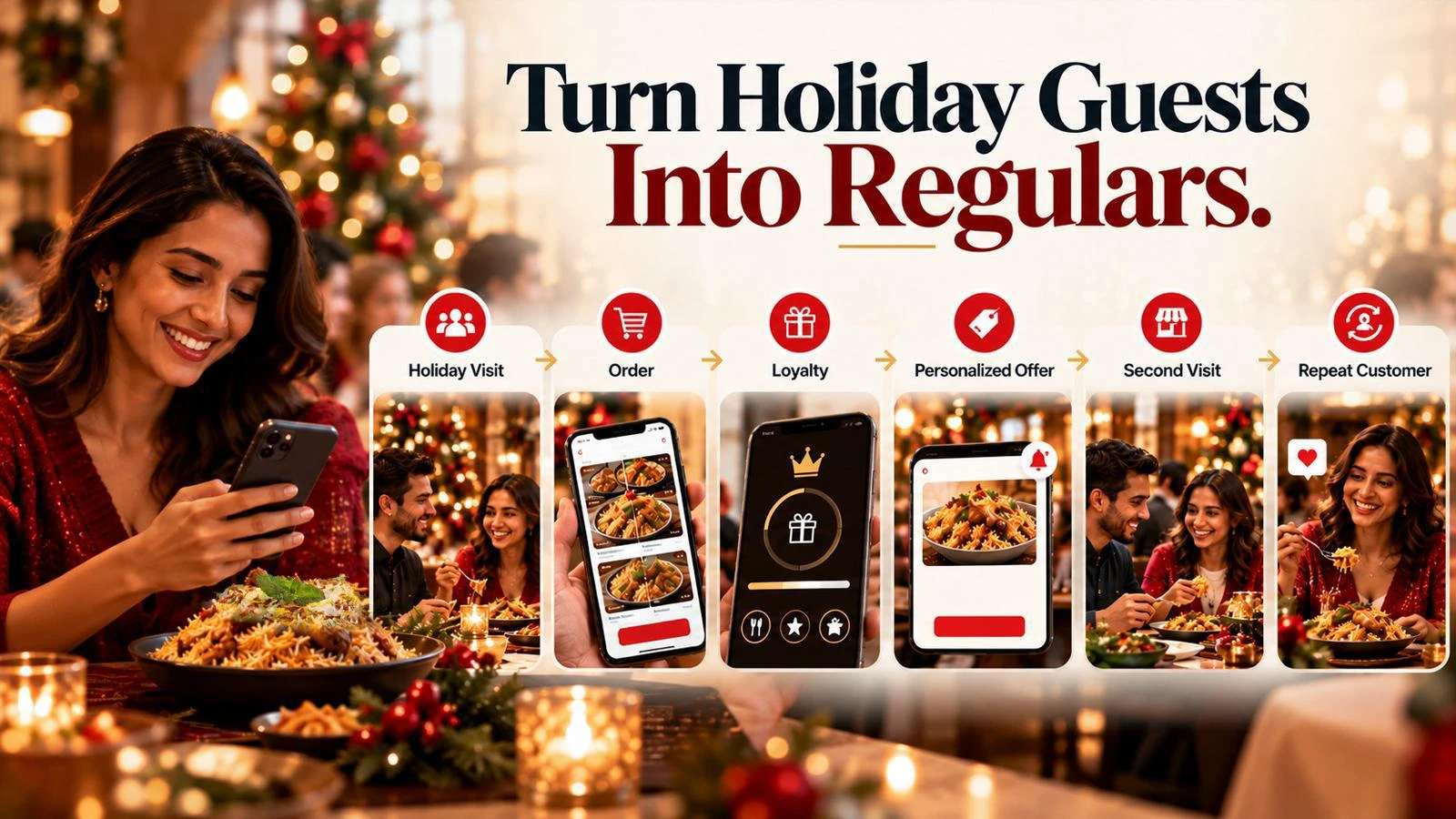
With Brisque POS as part of a broader restaurant technology setup, operators can evaluate how their POS, customer engagement, and loyalty tools work together. The precise loyalty features and integrations available should be confirmed for the restaurant's specific configuration.
8. Connect Marketing, Sales, and Restaurant Management Technology
Marketing, sales, and operations should not work as separate departments during the holiday season. A promotion may perform well online, but if the kitchen cannot fulfill the resulting orders, the customer experience suffers. Similarly, a restaurant may serve customers efficiently but miss opportunities to encourage repeat visits if it does not plan post-holiday engagement.
Restaurant Management Technology helps connect these activities when the right systems and workflows are in place. Consider a holiday family-meal campaign:
- 1
Marketing
The restaurant promotes a family bundle through its website, social media, and customer communications.
- 2
Ordering
Customers place advance orders through the available ordering channel.
- 3
POS and operations
Order details enter the supported workflow so staff can manage preparation and payment.
- 4
Sales monitoring
Managers review order counts and sales performance.
- 5
Customer engagement
The restaurant invites customers to return with an appropriate follow-up offer.
- 6
Evaluation
The team compares campaign costs, sales, order fulfillment, and repeat business.
This approach gives restaurant owners a more complete view of the campaign, from the first advertisement to the customer's next visit.
Brisque POS can be positioned within this process as part of the restaurant's operational foundation. The most effective setup will depend on the restaurant's selected Brisque features, available integrations, and wider technology stack.
9. How Brisque POS Can Support a Holiday-Ready Restaurant
For restaurants preparing for the winter season, Brisque POS can be part of a broader strategy to connect day-to-day restaurant operations with business growth objectives. The focus should be on choosing the right workflows for the restaurant and making sure staff can use them confidently.
Support organized order and sales workflows
A Restaurant POS system can provide a structured way to enter transactions and manage menu items. Restaurants should configure seasonal menus, bundles, pricing, and modifiers before promoting them to customers.
Help managers evaluate sales performance
Where available in the restaurant's Brisque configuration, sales reporting can help managers review seasonal item performance and compare promotional results. These insights can inform future menu and marketing decisions.
Connect digital ordering with restaurant operations
Restaurants should assess how their Brisque POS setup works with their chosen Restaurant Online Ordering System and other operational tools. The aim is to reduce unnecessary manual steps and give staff clear order information.
Support a more coordinated customer experience
A restaurant can plan loyalty and engagement campaigns around the customer journey, from the first holiday order to the next visit. Any required customer data, marketing permissions, and system integrations should be reviewed before launch.
Prepare for growth beyond the holidays
The benefits of a well-organized technology setup should extend into January and beyond. Restaurants can use what they learn from the holiday season to improve everyday ordering, review menu performance, refine promotions, and plan staffing and inventory more effectively.
Brisque's role should be understood in the context of the restaurant's actual products, configuration, and integrations. Before publishing specific feature claims or promising a particular business result, restaurants should verify those details with Brisque.
The objective is not to add technology for its own sake. It is to make the restaurant's existing marketing, sales, and service efforts work together more effectively.
10. Measure What Matters: Holiday Sales Metrics to Track
After the season ends, restaurant owners should review more than total sales. A useful performance review connects customer acquisition, order fulfillment, and profitability.
| Metric | What it helps you understand |
|---|---|
| Total holiday sales | Overall revenue generated during the campaign period |
| Average order value | Average amount spent per transaction |
| Promotion redemption rate | How often customers use a particular offer |
| Online order volume | Demand coming through digital ordering channels |
| Contribution margin | Revenue remaining after relevant variable costs |
| Repeat customer rate | Whether customers return after the holiday period |
| Order accuracy | How consistently orders are fulfilled correctly |
| Fulfillment time | How efficiently the restaurant handles orders |
| Customer feedback | What guests liked and what needs improvement |
| Marketing cost per acquired customer | How much the campaign spends to attract a new customer |
Set a baseline before launching a campaign. Compare performance with a suitable prior period, and account for differences in opening hours, pricing, capacity, and seasonal demand. Where possible, evaluate similar weekdays and comparable holiday periods instead of drawing conclusions from a single busy day.
A POS report can help with transaction-level measures, while marketing platforms, customer feedback systems, and operational records may be needed for other metrics. No single system should be assumed to provide every measure automatically.
Conclusion: Turn Holiday Demand Into Long-Term Restaurant Growth
The winter holiday season offers U.S. restaurants an opportunity to attract new customers, increase seasonal sales, strengthen local visibility, and build relationships that continue into the new year.
But sustainable results require more than a festive menu or a temporary discount. Restaurants need a coordinated plan that combines Holiday Sales Strategies, thoughtful Restaurant Holiday Promotions, effective Restaurant Digital Marketing, convenient online ordering, and meaningful Restaurant Customer Engagement.
Restaurant Management Technology and a well-configured Restaurant POS system can help support that plan by organizing orders, improving sales visibility, and connecting operational workflows where integrations are available.
For restaurants using Brisque POS, the opportunity is to build on their technology foundation, prepare staff for seasonal demand, evaluate promotional performance, and identify ways to make the customer experience more consistent.
Start early. Promote offers customers genuinely value. Make ordering straightforward. Measure profitability, not just revenue. And give every holiday customer a reason to return.
This holiday season, make every order count, and use what you learn to build a smarter restaurant business in the year ahead.
Ready to prepare your restaurant for the holiday rush?
Explore how Brisque POS can fit into your restaurant's technology strategy and help your team plan for a more organized, customer-focused season.
Talk to Our SpecialistsSources
- National Restaurant Association, 2026 State of the Restaurant Industry report.
- National Restaurant Association, 2025 industry research on restaurant technology investment.
- National Restaurant Association, 2024 Restaurant Technology Landscape research.